Crack the Code: Understanding Chiropractic Adjustments
Why get adjusted?
A chiropractic adjustment aims to restore joint motion and alignment, which can decrease any mechanical stress on the surrounding tissues. It can also improve the function of the nervous system and even decrease pain levels through endogenous analgesic effects (painkillers made by your body). Like with all techniques in the healthcare world, it is important to be informed on all Risks and Benefits before any procedure. Come in and learn if an adjustment is right for you.
What’s up with the crackin’?

That classic “crack” or “pop” you sometimes hear during a chiropractic adjustment isn’t a sign of broken bones or anything dislocating out of place. It actually comes from gas releasing from a joint! Think of it like opening a fizzy soda: the sound is just the gas escaping. The noise doesn’t mean anything is being damaged; it’s simply a natural part of how joints move and release pressure. Many people find it satisfying, but even if you don’t audibly hear anything, the adjustment can still be working just as effectively.
How does a chiropractor perform the adjustment?

HVLA (High-Velocity, Low-Amplitude) adjustments involve a quick, precise thrust over a short range of motion. This technique is usually what you think of when you watch videos of people getting that classic “pop” or cracking sound. You can use a lighter HVLA technique with an activator tool - this still applies a quick thrust however it may be more gentle, and the force can be controlled to whichever setting is needed. It’s great for people who need a softer approach, such as children, seniors, or pregnant patients. Even more gentle yet, LVLA (Low-Velocity, Low-Amplitude) adjustments use slow and repetitive movement with minimal force, making them ideal for sensitive areas in acute pain. These techniques will be used based on chiropractic evaluation of the joint, symptomatology, and patient comorbidities (i.e. osteoporosis).
How does it work in the body?
Chiropractic adjustments increase your range of motion by releasing any restrictions in the joint that may limit its movement. When a joint is “stuck” or restricted, the surrounding muscles, ligaments, and joint capsule tighten, which prevents it from moving fully. An adjustment can loosen the aforementioned structures, restore the joint glide and rotation, and even encourage more functional movement patterns.
By gently freeing up stiff or restricted joints, chiropractic adjustments help take pressure off the nerves that exit the spine. This can improve the “communication” between your brain and muscles, helping your body move better, feel better, and work more efficiently overall.
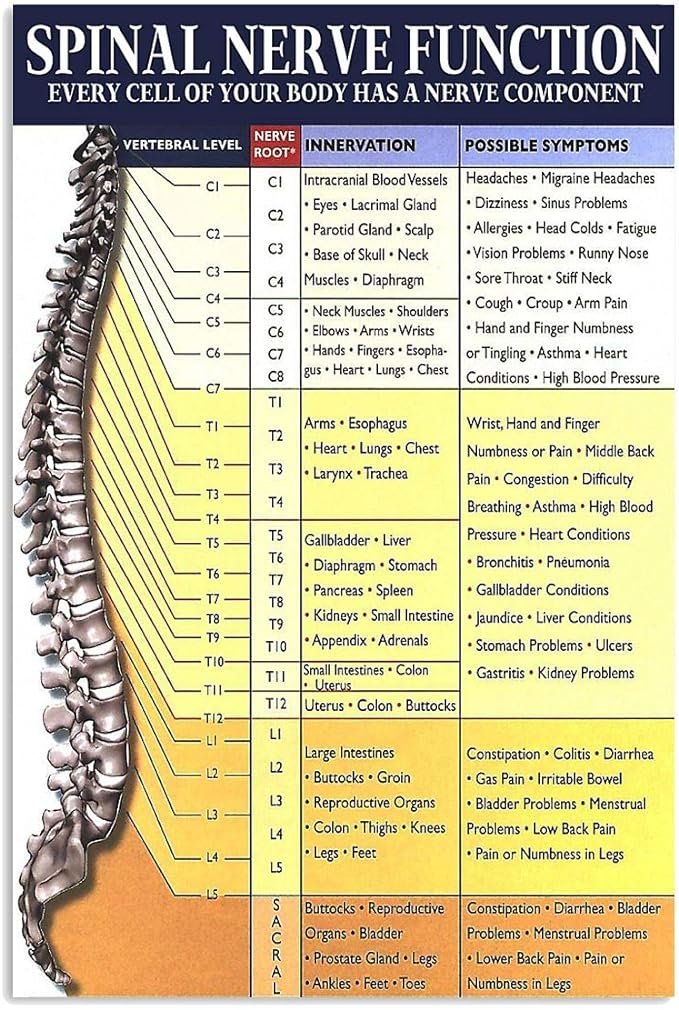
While on the subject of nerves, we should also consider that spinal nerves that innervate our organs, not just the muscles. The autonomic nervous system (ANS), part of the peripheral nervous system, unconsciously regulates various involuntary functions like heart rate, digestion, respiration to maintain homeostasis, and more. This is achieved through the ANS's two main divisions: the sympathetic (“fight or flight”) and parasympathetic (“rest and digest”) nervous systems. Getting adjustments can influence the autonomic nervous system and thus may reduce sympathetic or support parasympathetic activity depending on the spinal level affected (i.e. sacrum, lumbars). Decreasing stress on the nervous system at the restricted joint can help calm the body, promote relaxation and recovery, and improved regulation of various bodily functions. See chart below for some brief examples of what's innervated by each spinal level.
Chiropractic adjustments may influence blood flow and circulation, which can be key to targeting inflammation as well as healing. This can be local or further from the spine/ joint. For example, improving ANS signaling can affect overall vascular tone, as a result promoting vessel relaxation, supporting more efficient blood flow to tissues, and more. It can also improve more local blood flow to the area targeted to help get those nutrients and oxygen to healing areas more efficiently.
Adjustments can also improve proprioception, or your body’s ability to sense where your joints and muscles are in space. The nerves around restricted segments may send altered or diminished signals to the brain, making it harder for your body to coordinate movement accurately. When an adjustment improves the joint motion/position itself and thus “resets” the environment of those sensory nerves, as a result, the nerve’s feedback to the brain improves because that faulty pattern has been corrected. This corrected communication pattern helps your muscles respond more efficiently, improves balance, coordination, and movement control.
There are many interesting physiological effects that an adjustment can have on the body. We must think of the body as interconnected, because each organ, muscle, liganent, and bone does not exist in isolation but functions as part of a greater, integrated whole. The human body is amazing!